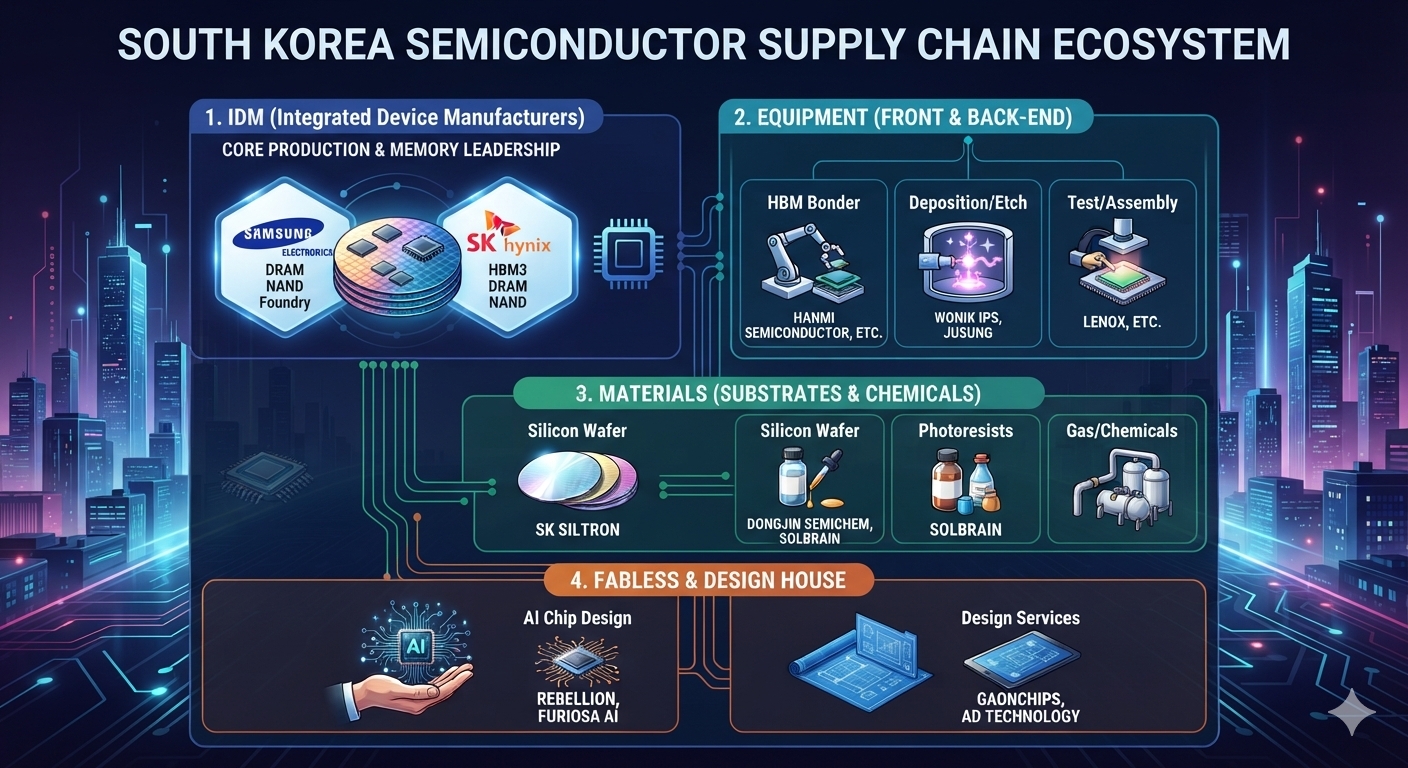
The South Korean equity market (KOSPI) remains at a crucial juncture, navigating through global macroeconomic shifts, federal monetary policies, and earnings releases from key semiconductor heavyweights. As global tech sentiment fluctuates, international investors closely watch the Korean market as a leading barometer for global trade and tech supply chains.
This report provides an in-depth analysis of the current South Korean stock market, highlighting key drivers such as the semiconductor cycle, foreign capital movements, and risk management strategies for investors in July 2026.
- Market Sentiment: KOSPI is heavily influenced by global tech earnings and semiconductor demand dynamics.
- Pillar Sectors: Tech giants including Samsung Electronics and SK Hynix continue to account for a significant portion of market capitalization and trading volume.
- Foreign Flow: Foreign institutional buying and selling behaviors serve as a primary catalyst for short-term market direction.
- Strategic Focus: Investors are advised to balance tech exposure with defensive dividend assets amidst macroeconomic uncertainties.
1. Overview of the Current South Korean Stock Market (KOSPI)
South Korea’s benchmark index, the KOSPI, reflects the broader trends of the global tech supply chain. Given Korea’s export-driven economy, market performance is tightly coupled with global demand for memory chips, consumer electronics, and automotive tech.
- Export Dependence: Korean market earnings heavily correlate with global trade volume and macroeconomic health in major markets.
- Institutional Dynamics: Market moves are frequently amplified by foreign capital flows and domestic institutional rebalancing.
2. Key Market Drivers: Semiconductor Giants & Global Tech Volatility
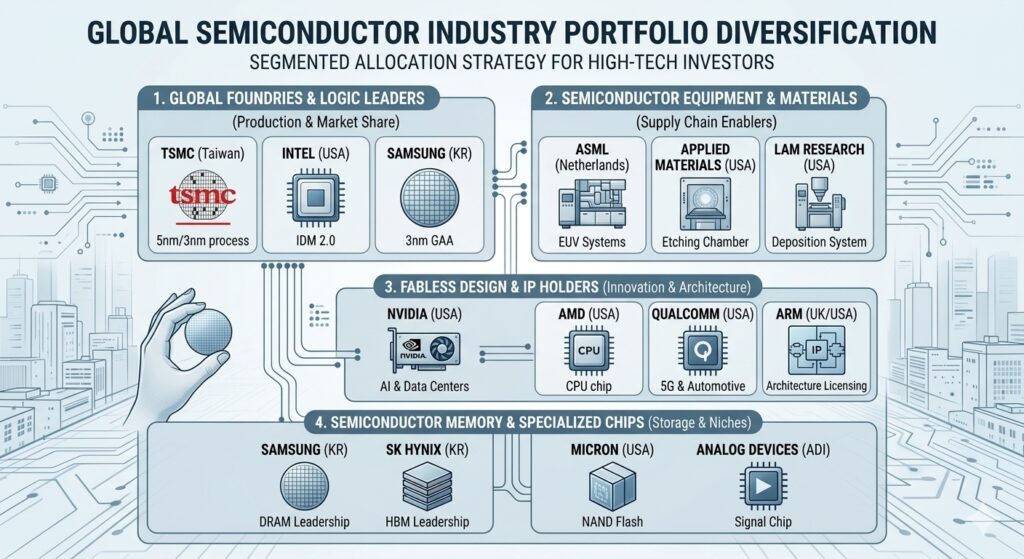
The performance of semiconductor leaders—namely Samsung Electronics and SK Hynix—remains the single most influential determinant of KOSPI movement.
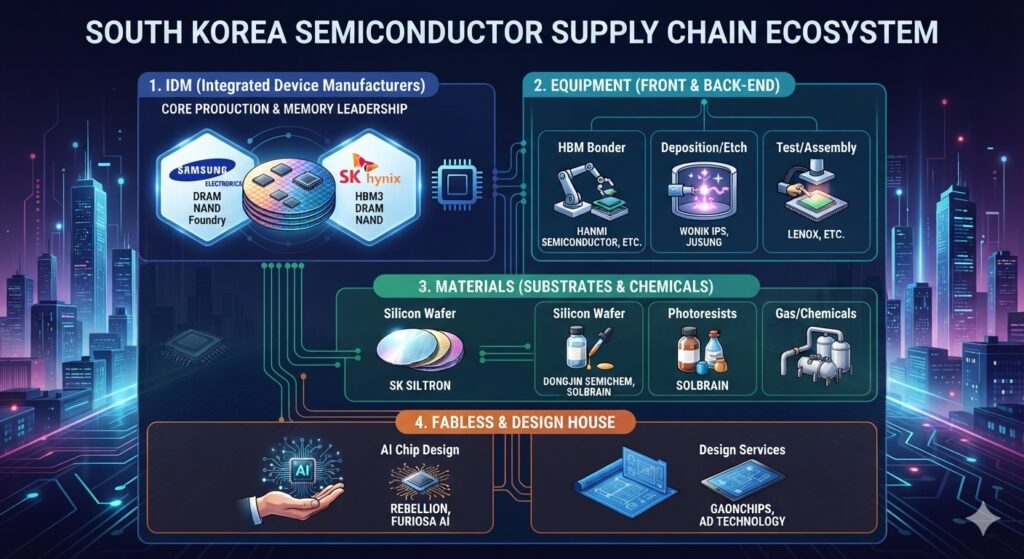
- AI Infrastructure & Memory Cycles: High Bandwidth Memory (HBM) demand and conventional DRAM/NAND pricing cycles directly dictate corporate margins.
- Global Tech Earnings Spillovers: Guidance and CAPEX announcements from US tech bigs frequently set the tone for Korean supplier valuations.
3. Quantitative Market Breakdown & Sector Performance
A summary of sector sensitivity and key driver dynamics within the Korean stock market:
| Sector / Asset Class | Market Weight | Key Catalyst | Outlook & Sensitivity |
|---|---|---|---|
| Semiconductor / Tech | High (~30%+) | HBM Demand & Global Big Tech CAPEX | High Volatility / Growth Driver |
| Automotive & EV Battery | Medium-High | Global EV Adoption & Export Tariffs | Moderate Growth / Policy Dependent |
| Financials & Holding Cos | Medium | Government ‘Corporate Value-up’ Program | Defensive / High Dividend Yield |
| Bio & Healthcare | Medium | Pipeline Approvals & CMO Contracts | Growth / Independent Cycle |
4. Foreign Capital Movement & FX Sensitivity
Foreign investors play a dominant role in price discovery on the KOSPI. A weakening Korean Won (higher USD/KRW exchange rate) often prompts foreign profit-taking, whereas a stabilizing currency invites aggressive foreign net-buying.
5. Strategic Portfolio Asset Allocation
💡 Investor Simulation & Portfolio Strategy Example
Below is a balanced allocation framework for investors looking to gain exposure to South Korean equities while mitigating downside risks.
- Core Growth (40%): Top-tier semiconductor and AI supply chain leaders (e.g., Samsung Electronics, SK Hynix).
- Value & Dividend Shield (30%): Banking, automotive, and holding companies benefiting from shareholder return initiatives.
- Tactical Growth (20%): Secondary battery suppliers, defense manufacturers, or biotech firms with strong export momentum.
- Cash / Short-term Liquidity (10%): Held in USD/KRW short-term instruments to capitalize on market corrections.
✅ Investor Action Checklist
- [ ] Monitor daily foreign net buying/selling trends on the KOSPI
- [ ] Track quarterly earnings guidance from major Korean tech exporters
- [ ] Evaluate USD/KRW exchange rate stability before making major entries
- [ ] Check corporate governance and dividend yield enhancements under Korean value-up policies
6. Frequently Asked Questions (FAQ)
Q1. Why are Korean stock markets so sensitive to global semiconductor news?
A1. Semiconductors constitute over 20% of South Korea’s total exports and a massive portion of the KOSPI’s total market capitalization. Consequently, global chip demand directly impacts national earnings and stock index levels.
Q2. How does the ‘Corporate Value-up Program’ affect Korean stock valuations?
A2. Initiated to address the historical ‘Korea Discount,’ this policy encourages listed companies to increase shareholder returns, cancel treasury shares, and improve capital efficiency, offering long-term re-rating potential for undervalued stocks.
Q3. What is the ideal entry timing for foreign investors looking into Korean equities?
A3. Favorable entry points typically emerge when USD/KRW exchange rate volatility stabilizes and foreign institutional investors shift back into net-buying positions following global tech earnings pullbacks.
Q4. How do US monetary policy decisions influence KOSPI?
A4. Interest rate decisions by the US Federal Reserve impact the interest rate differential with the Bank of Korea, affecting foreign capital flows and exchange rate stability, which in turn influences KOSPI momentum.
Q5. Is KOSDAQ significantly different from KOSPI?
A5. Yes, KOSDAQ is heavily weighted toward small-to-mid-cap growth companies in biotech, secondary batteries, and tech hardware, presenting higher volatility and higher growth potential compared to the mature mega-caps on KOSPI.
7. Related Articles
- Global Semiconductor Industry Outlook & Memory Cycle Analysis
- South Korea Macroeconomic & Central Bank Rate Policy Updates
- Foreign Exchange Strategy: Managing USD/KRW Volatility